BioArt is an art practice where humans work with live tissues, bacteria, living organisms, and life processes. Using scientific processes such as biotechnology (including technologies such as genetic engineering, tissue culture, and cloning) the artworks are produced in laboratories, galleries, or artists' studios.
The scope of BioArt is considered by some artists to be strictly
limited to “living forms”, while other artists would include art that
uses the imagery of contemporary medicine and biological research, or
require that it address a controversy or blind spot posed by the very
character of the life sciences.
Although BioArtists work with living matter, there is some debate as
to the stages at which matter can be considered to be alive or living.
Creating living beings and practicing in the life sciences brings about ethical, social, and aesthetic inquiry. The phrase "BioArt" was coined by Eduardo Kac in 1997 in relation to his artwork Time Capsule. Although it originated at the end of the 20th century through the works of pioneers like Joe Davis and artists at SymbioticA, BioArt started to be more widely practiced in the beginning of the 21st century.
BioArt is often intended to be shocking or humorous. One survey of the field in Isotope: A Journal of Literary Science and Nature Writing
puts it this way: "BioArt is often ludicrous. It can be lumpy, gross,
unsanitary, sometimes invisible, and tricky to keep still on the auction
block. But at the same time, it does something very traditional that
art is supposed to do: draw attention to the beautiful and grotesque
details of nature that we might otherwise never see."
While raising questions about the role of science in society, "most
of these works tend toward social reflection, conveying political and
societal criticism through the combination of artistic and scientific
processes."
While most people who practice BioArt are categorized as artists in
this new media, they can also be seen as scientists, since the actual
medium within a work pertains to molecular structures, and so forth.
Because of this dual-acceptance, the Department of Cell Biology at
Harvard University invites anyone to submit works based on scientific or
artistic value. This can encourage anyone to submit work they strongly respond to.
Monday, 25 August 2014

Building Flowers
An architecture graduate
constructs intricate botanical illustrations using the computer graphics
programs intended to design buildings.
 A SCREENSHOT FROM A VIDEO PRODUCED BY PANASONIC HOLLYWOOD LABS (PHL) FEATURING MURAYAMA'S WORK
What’s the difference between a 100-story skyscraper towering over a bustling metropolis and a 2-inch flower blooming in the countryside? To architecture-student-turned-artist Macoto Murayama, not a whole lot.
“[The flower] is organic and is rather different from architecture [in that way],” Murayama writes in an email (translated by Rodion Trofimchenko, a curator at the Frantic Gallery in Tokyo, Japan, where Murayama shows his work). “[But] when I looked closer into a plant that I thought was organic, I found in its form and inner structure, hidden mechanical and inorganic elements.”
Intrigued, Murayama began applying the computer graphics programs and techniques he had learned while studying architecture at Miyagi University of Education in Sendai to illustrate, in meticulous detail, the anatomy of flowers. After choosing a flower, purchased at the flower shop or picked up on the side of a road, he carefully dissects it, cutting off its petals with a scalpel and extracting the ovary and other internal structures. He then sketches what he sees, photographs it, and models it on the computer using 3dsMAX software, a program typically used by architects and animators. Finally, he creates a composition of the different parts in Photoshop, and uses Illustrator to add measurements and other labels.
“His images are very beautiful,” says Linda Ann Vorobik, a professional botanical illustrator affiliated with the Herbarium at University of California, Berkeley, and University of Washington, Seattle. “He’s trying to present a scientific illustration style to show the various details, but then he’s spinning it with a lot of techniques that are dependent upon high-tech tools to create images that are pleasing to the eye.”
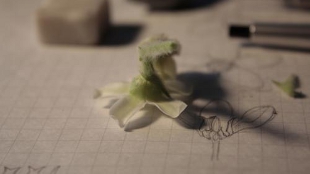
Curator Trofimchenko first saw Murayama’s work at the Art Award Tokyo Marunouchi Exhibition in 2009. “It was, of course, not as strong as [his] recent works, but anyway outstanding: contemporary media, explicit union of tradition and experiment, and obvious root of that image in personal interest (obsession) of its author,” Trofimchenko writes in an email. Impressed, he and Frantic Gallery director Yasunobu Miyazaki approached Murayama at the opening reception and asked if he’d be interested in showing his art in the gallery.
Murayama completed his BA in spatial design at Miyagi University and a post-graduate degree in media expression at the Institute of Advanced Media Arts and Sciences (IAMAS). In addition to working on his art, he holds a part time job at a flower shop, running deliveries and assisting with production, design, and photography.
“The reason I am working at the flower shop is that I cannot support myself only with my art works, which is a negative side, but I can also see how people who deal with flowers and plants, think about them, how they perceive them, which is a positive side,” Murayama says. “I am sure that in the future this experience will come to live in my thinking and my works.”
Murayama says his current illustrations are purely an “artistic expression,” but he could see turning to more scientific endeavors down the road. Vorobik isn’t sure if his style will be easily accepted by the scientific community, however. “The reality in publication is that the bottom line matters,” she says. “For so many years, line drawings have been the cheapest way to illustrate stuff. It’s a matter of efficient cost.”
The term “New Media” is expanding,
since its emergence out of Pop Art, Fluxus, and other earlier movements,
to mean many things. It is digital, it is interactive, it is dynamic,
it is animated, it is dangerously hactivist…it is an expression of
changing times and cultures, of the horizon called the future coming
closer to us. One particular instance of New Media which has branched
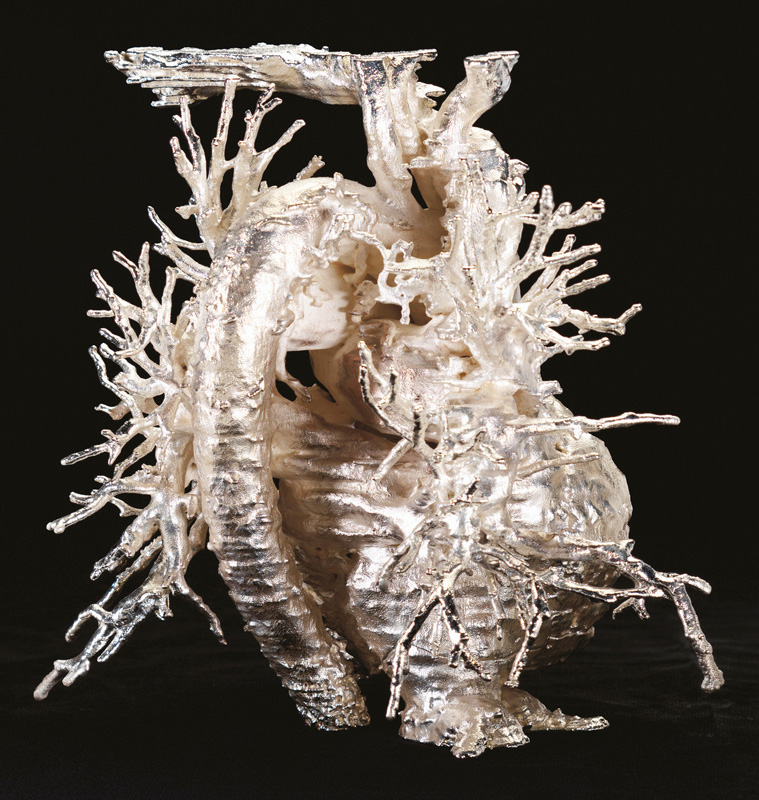
out into its own discipline is “Bio Art,” such as that practiced by
British artist Jane Prophet in her project Silver Heart, seen below.
Bio Art relates not only to biological
sciences, but to engineering, robotics, and architecture, which follow
the same structural principles in building complex forms. One example
of architectural influence in Bio Art is the work of Macoto Murayama, a
graduate student from Miyagi University of Education who uses his
expertise to create beautiful, fluid forms like flowers. In speaking of
the relation between the plant and digital technology, he notes:
“[The flower] is organic and is rather different from architecture
[in that way][...][But] when I looked closer into a plant that I thought
was organic, I found in its form and inner structure, hidden mechanical
and inorganic elements.” (The Scientist, p.1). The two worlds
are, after all, not so separate. Nature and technology merge ever more
seamlessly with the integration of various disciplines into New Media
Art.
The term Bio Art was first coined by
Eduardo Kac, an American artist born in Brazil. Kac is well versed in
the fields of biotechnology and genetics, and employs his expertise in
various art projects to critique said fields of study, along with
scientific techniques in general. A good example of this strategy is
Kac’s first “transgenic” piece, “Genesis.” This work is not only an
expansion of the realm of Bio Art, but of art as a complicated series of
processes leading to a perhaps far less complicated end result. In
Genesis, the “art” lies mainly in the concept and execution: the display
is merely gloss. Kac takes this quote from the Bible: “And God said,
Let us make man in our image, after our likeness: and let them have
dominion over the fish of the sea, and over the fowl of the air, and
over the cattle, and over all the earth, and over every creeping thing
that creepeth upon the earth,” and turns it into Morse Code.
He translates that information into the base pairs, A-T, G-C of the
fundamental double helix DNA structure, then turns them into the
theoretical genetic sequences which would be created from that
data, then implants that genetic material into bacteria and swabs the
entire amalgamation onto a petri dish.
Viewers (via webcam) are given the option
to turn on a UV light above the dish, triggering mutation and
destroying the fragile links between the quote and the organisms if they
disagree with the statement therein expressed. However, in doing so
they themselves exert dominace over nature, contradicting their initial
perspective. The art lies in the dichotomous choice a viewer must make,
whether to change what he does not agree with, or conversely, be passive
about that which he holds true (for those accepting the statement would
not wish to manipulate the bacteria and destroy the statement). It
addresses the gap between human reason and action. For instance, how
does one uphold pacifism? One cannot force an invading army to stop
killing, while upholding a rule of no fighting.

Such questions, and many other interesting dilemmas, are at the forefront of exploration in Bio Art.
It is a strange direction to take, and a
strangely inverted view of the world: that the internal workings and
functions of objects such as flowers or the human body should be their
celebrated components, rather than the outer forms so praised by artists
of the past, is a perspective not merely strange, but contentious to
many. It will be interesting to see where Bio Art, and the rest of the
broadly expanding behemoth that is New Media, goes next.
References:
http://www.janeprophet.com/2011/09/rapid-prototype-sculpture-art-3d-printer-polymer-algorithn-silver-heart-2004/
http://the-scientist.com/2012/02/16/building-flowers/
http://ekac.org/geninfo2.html
John Kalymnios
Another work:
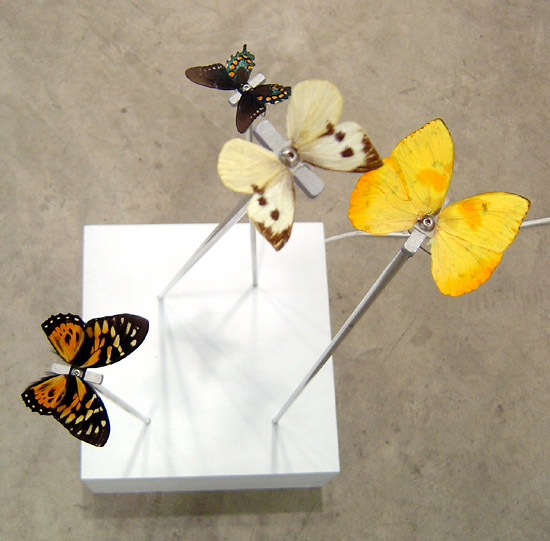
John Kalymnios, Untitled (Butterfly) (detail), 2003
29 butterflies mounted on aluminum,
motors, each 4 1/2 X 6 inches, variable heights
Collection of Kemper Museum of Contemporary Art
Kalymnios
does not merely deconstruct nature, he perfects it. He extracts from it
the reverie and serenity it can bring us in our most elevating encounters
with it, and then frees it from the deterioration of time by adding mechanical
elements. On occasion, Kalymnios's kinetic sculptures even resurrect nature,
as with Untitled (Butterfly) (2003) in which 29 dead butterflies
are given new life. As miraculous as the new life from the cocoon in nature
may be, it is fleeting; Kalymnios, however, allows the miracle to live
on by animating the insects with the help of motorized wires. What results
is a flock of iridescent butterflies moving their delicate wings in a
simulation of flight, long after their demise. Kalymnios's ability to
eternalize the new life of the butterfly recalls Yeats's line, “Once out
of nature, I shall never take my bodily form from any living thing/but
such a form as Grecian goldsmiths make … set upon a golden bough to sing
… of what is past, passing, or to come.”
Friday, 15 August 2014
Cedric Laquieze
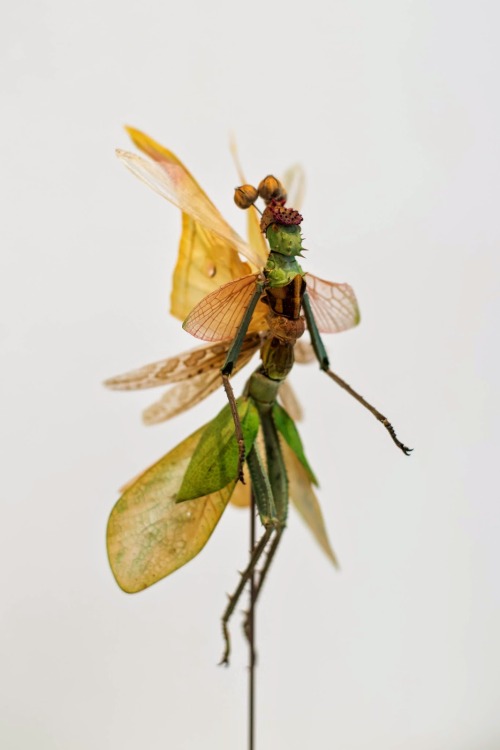
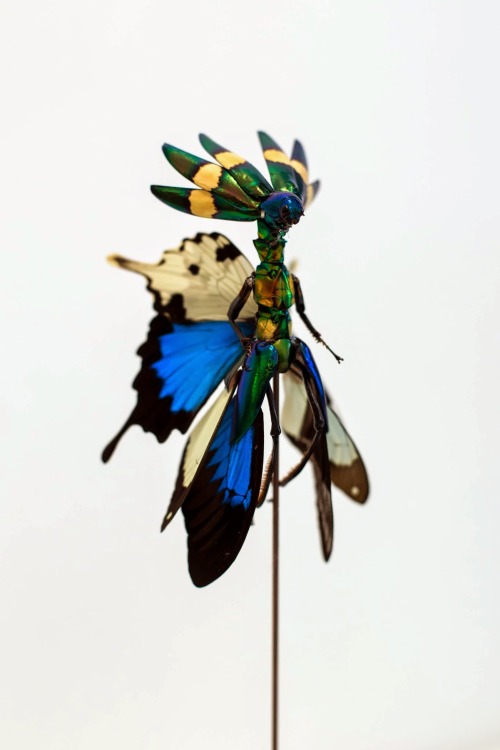
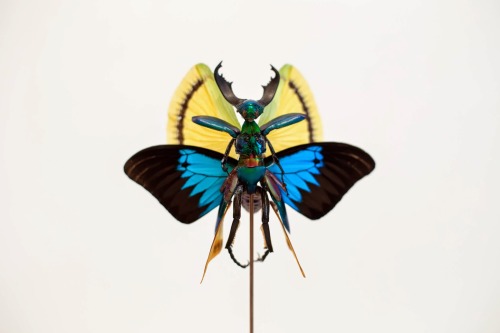
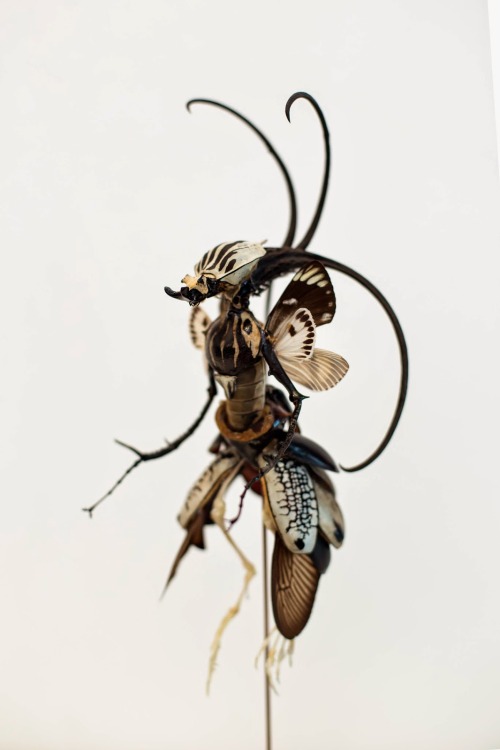
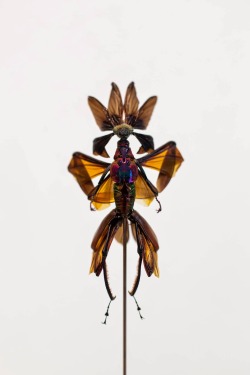
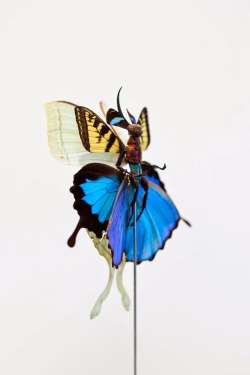
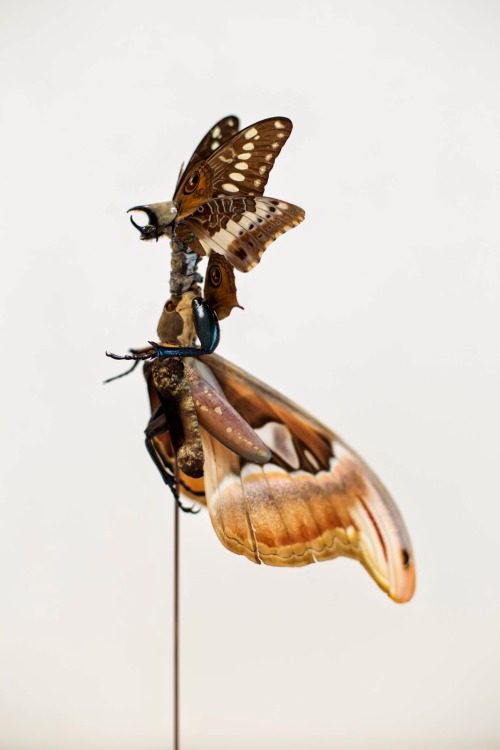
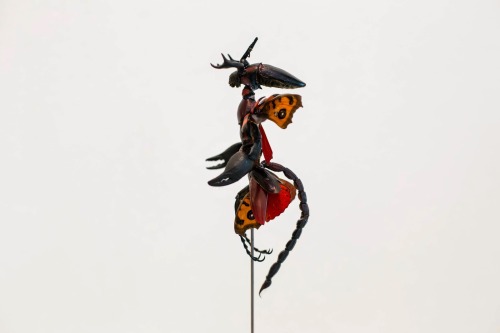
Amsterdam-based artist Cedric Laquieze (previously featured here) recently completed a fascinating new series of his exquisite taxidermy Fairies.
These delicate sculptures are primarily composed of parts from many
different insect species, but if you look closely you’ll notice bones,
seeds and even a few scorpion parts as well.
More here: http://laquiezecedric.blogspot.co.uk/2014/08/fairies-2014.html
More here: http://laquiezecedric.blogspot.co.uk/2014/08/fairies-2014.html


Wednesday, 30 July 2014
Ferraria Crispa


The bizarre Ferraria crispa - the "Starfish
Iris" - looks like it crawled out of the sea. This rare Iris
relative from South Africa has beautifully intricate blooms with frilly
edges. Ferraria crispa is a
winter-growing bulb that flowers in spring, then goes dormant for the
summer. Its attractive leaves emerge
from small corms in autumn. The leaves grow about a foot tall and have a
thick, fleshy texture. In late winter or early spring, the 1½
inch flowers
appear.


Fist looking at these flowers, they appear to be some kind of flower-coral hybrid. I have seen the ruffled edges described as being barnacle like, which I can really see. To me, they almost look "ornate" with their elaborate and highly decorative patterns and colours.
Saturday, 26 July 2014
Hubert Duprat

Trichoptera (caddis larva) building case (studio view), 1980-2000. Material: Gold, pearls, turquoise. Length: 2.5 cm. Photographer: Frédéric Delpech. Image courtesy of the artist and Art:Concept gallery, Paris and MONA Museum of Old and New Art.

Right now, in almost every river in the world, some 12,000 different species of caddisfly larvae wriggle and crawl through sediment, twigs, and rocks in an attempt to build temporary aquatic cocoons. To do this, the small, slow-moving creatures excrete silk from salivary glands near their mouths which they use like mortar to stick together almost every available material into a cozy tube. A few weeks later a fully developed caddisfly emerges and almost immediately flies away.
After first learning about caddisflies, self-taught (and self-professed amateur) artist Hubert Duprat had a thought. Had a caddisfly ever naturally encountered a fleck of gold in a river and used it to build a home? And then one step further: what if a caddisfly had only gold and other precious stones or jewels to work with?
Trichoptères, French for the scientific name of the caddisfly, is Duprat’s answer to that question. For years the artist has been collaborating with the tiny insects, providing them small aquariums of gold, turquoise and pearls that the the larvae readily use to construct their temporary homes. Regardless of how creepy crawly you might find the insects, it’s impossible to deny the strange beauty of the final product, tiny gold sculptures held together with silk. Encountering them void of any context, one would assume they were constructed by a jeweler.
Duprat currently has a solo exhibition at the Museum of Old and New Art in Tasmania which runs through July 28th, and it should be notced thath is work with caddisflies is only one small aspect of his art practice.

Trichoptera larva with case, 1980-2000. Material: gold and pearls. Dimension: 0.5 x 1.9 cm. Photographer: Frédéric Delpech. Image courtesy of the artist and Art:Concept gallery, Paris and MONA Museum of Old and New Art.

Trichoptera larva with case, 1980-2000. Material: gold and pearls. Dimension: 0.5 x 1.9 cm. Photographer: Frédéric Delpech. Image courtesy of the artist and Art:Concept gallery, Paris and MONA Museum of Old and New Art.

Trichoptera (caddis larva) case. Photographer: Fabrice Gousset.

Trichoptera (caddis larva) case on pedestal. Photographer: Fabrice Gousset.

Trichoptera (caddis larva) case. Photographer: Fabrice Gousset.

Trichoptera (caddis larva) case on pedestal. Photographer: Fabrice Gousset.

Trichoptera (caddis larva) case. Photographer: Fabrice Gousset.

Trichoptera (caddis larva) case on pedestal. Photographer: Fabrice Gousset.


From here.
Friday, 25 July 2014
Lindsay Feuer
Artist website
Suspended in the realm between reality and fantasy, my sculptures explore the organic process of growth, replication, and locomotion.
Deliberately ambiguous combinations of biological imagery reflect the perfect integration of form and function found in the natural world. Through an intuitive process, I allow these elements to respond to one another, creating “hybrid” forms with movement and fluidity.


Lindsay Feuer is a ceramic artist born and raised outside of Philadelphia. She creates unique and whimsical porcelain sculptures inspired by organic forms in nature. These works are a “hybrid” blend of fantasy and reality executed in highly detailed unglazed porcelain.
Suspended in the realm between reality and fantasy, my sculptures explore the organic process of growth, replication, and locomotion.
Deliberately ambiguous combinations of biological imagery reflect the perfect integration of form and function found in the natural world. Through an intuitive process, I allow these elements to respond to one another, creating “hybrid” forms with movement and fluidity.
Porcelain is an ideal medium for my work because its white luminescence showcases rich surfaces and curvilinear components.The strength and responsiveness of this clay also enables me to achieve whimsical and delicate sculptural elements. Hidden building techniques allow my sculptures to exist in
a space of seamless illusion where they appear “born” rather than
“made.” Inspired by the mysteries of nature, pieces deliver an animated
and fantastical view of our biological surroundings. I invite my
audience to draw upon their experience and imagination, and to discover a
unique reality for each piece.
Lindsay Feuer is a ceramic artist born and raised outside of Philadelphia. She creates unique and whimsical porcelain sculptures inspired by organic forms in nature. These works are a “hybrid” blend of fantasy and reality executed in highly detailed unglazed porcelain.
Himalayan Balsam
The Himalayan balsam grows up to 10ft (3m) tall and has colonised large areas beside rivers and woods throughout Britain, smothering any indigenous plants. The Environment Agency, Plantlife, Wildlife Trusts and the National Trust all say the species is a headache, and its total removal could cost as much as £300m.
But, with its pink orchid-like flowers, it is also attractive to many people. It’s so attractive, in fact, that a big factor in its invasive spread is people scattering its seed in the wild, according to research by Professor Ian Rotherham of Sheffield Hallam University and author of Invasive and Introduced Plants and Animals.
The upshot is that there is barely a part of lowland Britain free of this pretty menace. Fat stands of it clog small streams in places such as Somerset, and mass on the banks of rivers and woods from Cornwall to Scotland, with Norfolk, the Isle of Wight, New Forest, Hampshire, County Durham, Yorkshire, west Cumbria, Lancashire and North and South Wales especially troubled by it. The species is so prolific near Liverpool that it is known there as “Mersey weed”. Himalayan balsam grows in almost impenetrable thickets and will bully out any other species; its plentiful nectar means that bumble bees pollinate it rather than native species, and, being an annual, it dies down, leaving riverbanks bare in winter.It's interesting to consider that fact that this is an invasive species, yet has spread so far because people have found it to be so attractive! Using it's flowers as a means to spread further.
A discovery on a walk turned out to be very useful!
While out on a walk to enjoy the sun while it's here, and in addition to give myself time to gather more inspiration from nature and to think about the direction I wish to take future work, I came across these flowers.


 Not having much knowledge of plant identification, or wildflowers in the area, I made the assumption that based on the appearance of the flowers that they could be a species of orchid. This was based on the overall aesthetic of the flowers, the colours, patterns found on them and their seeming similarities to many orchids I have previously seen.
I didn't take any clear photographs of the leaves, I was completely captured by how beautiful and unusual I found these flowers to be, having never seen anything like it in the area, or before on any of my walks. It was like making a completely new discovery, of course it turned out to be a new discovery only for me in knowledge gained from learning about this plant. The only thing I could gather was that lots of these plants were growing amongst a similar amount of Great Willowherb plants, most of which were taller than myself.
Wanting to identify these flowers, I spent many hours using Google, finding many websites about UK wildflowers and orchids found in the wild, reverse image searching using my photographs, but found nothing that helped me identify these flowers. I thought they could be Early Purple orchids, but finding these in July when they flower at the latest in June, and very few similarities made it doubtful.
I then happened across a blog post listing many different flowers in Endon, and saw these flowers! They are not what I was expecting at all, and are called Himalayan Balsam. They are a fast growing, invasive species that can spread their hundreds of seeds with exploding seed pods reaching up to 7 meters away, thus spreading quickly. They also smother other plants and vegetation as they grow and are dubbed a problem weed in many areas where they completely take over. They did however attract a lot of bees.
Wikipedia page on the Himalayan Balsam.
It's really interesting to discover all of this information about this plant. What I thought was a beautiful flowering plant turns out to be an extremely aggressive, invasive plant. What makes this find even more interesting to me is the ideas I have been researching and developing in previous work, such as parasitic fungi, and the ideas of subtle danger within my imagined organisms. I think this plant offers a lot of answers for me, in addition to just as many ways to further strengthen and develop my ideas further.
I think I should really consider revisiting the site I found them, and document it fully through various methods.
I didn't take any clear photographs of the leaves, I was completely captured by how beautiful and unusual I found these flowers to be, having never seen anything like it in the area, or before on any of my walks. It was like making a completely new discovery, of course it turned out to be a new discovery only for me in knowledge gained from learning about this plant. The only thing I could gather was that lots of these plants were growing amongst a similar amount of Great Willowherb plants, most of which were taller than myself.
Wanting to identify these flowers, I spent many hours using Google, finding many websites about UK wildflowers and orchids found in the wild, reverse image searching using my photographs, but found nothing that helped me identify these flowers. I thought they could be Early Purple orchids, but finding these in July when they flower at the latest in June, and very few similarities made it doubtful.
I then happened across a blog post listing many different flowers in Endon, and saw these flowers! They are not what I was expecting at all, and are called Himalayan Balsam. They are a fast growing, invasive species that can spread their hundreds of seeds with exploding seed pods reaching up to 7 meters away, thus spreading quickly. They also smother other plants and vegetation as they grow and are dubbed a problem weed in many areas where they completely take over. They did however attract a lot of bees.
Common name Himalayan balsam, Indian balsam, jumping jack, policeman's helmet
Botanical name Impatiens glandulifera
Areas affected Gardens and allotments, often those adjacent to infested riverbanks and waste places
Main causes Fast-growing annual spreading by seed
Timing Seen spring to autumn; treat in early summer
The Himalayan balsam (Impatiens glandulifera) is an erect, annual plant, with large, oblong leaves which have sharply serrated edges. The reddish stems of the Himalayan balsam are translucent and succulent. The leaves are also succulent and may be arranged opposite each other or in whorls of three.
Where it has been introduced, the Himalayan balsam often produces more nectar than many of the native species, making its flowers more attractive to pollinating insects than those of other plants living in close proximity. It also outcompetes native species for light and space, as its large size and high rate of reproduction facilitates rapid colonisation. The rapid growth of this species can be extremely problematic around water systems, where it can increase the rate of erosion and obstruct water flow, subsequently increasing the risk of flooding.
Wikipedia page on the Himalayan Balsam.
It's really interesting to discover all of this information about this plant. What I thought was a beautiful flowering plant turns out to be an extremely aggressive, invasive plant. What makes this find even more interesting to me is the ideas I have been researching and developing in previous work, such as parasitic fungi, and the ideas of subtle danger within my imagined organisms. I think this plant offers a lot of answers for me, in addition to just as many ways to further strengthen and develop my ideas further.
I think I should really consider revisiting the site I found them, and document it fully through various methods.
Thursday, 17 July 2014
Melissa Gamwell


Melissa Gamwell is an artist and writer based in New York. A recent graduate from the Royal College of Art, she currently works with a focus on abstraction of functional industrial objects, creating one-off pieces primarily in ceramic and metal.
Wednesday, 16 July 2014
A Day Job is Not an Art Crime
A Day Job is Not an Art Crime
colleendoran:
While I don’t want to be the voice of reason that buzzkills your art dreams, the fact is few people can make a full- time living in this business. Fewer still can sustain a long term career in the creative arts.
It’s hard to know when to let something go. Or when to keep pushing through.
Many creators lie to themselves and everyone else about their professional prospects. They don’t want to be seen as a loser. Many people will even advise you not too be too honest in public about how hard you are struggling. People seek out entertainment to escape their problems, not to be made to feel responsible for yours.
Instead of getting a day job between assignments, some artists sit for months or years without paying gigs. They incur huge debts they can never repay, or take lousy assignments they’re ashamed of, always hoping for the big payday that never comes.
Not being a full-time creator is not some kind of art crime. Sometimes it is better to get that day job and do art on the side. You may even appreciate art making more when you don’t have to rely on art for money.
This job has no benefits, no guarantees. Nothing. If you don’t make enough money to pay for every dime of your health care, your retirement, and all your business expenses, as well as your daily living needs, you are not making it as a professional creator. Getting by is not good enough.
Self awareness is key in this business, and some creators just don’t have it. They live on dreams.
But dreams don’t pay the bills.
It is possible to have that day job and have your dreams nights and weekends, you know. Let some other job finance those dreams with benefits.
Free yourself from other people’s expectations about what being a successful artist means. If necessary, get that other job, and look at it as your other job. You don’t have to frame your art making by other people’s standards.
Not being a full-time professional creator does not make you any less an artist.
A day job is not an art crime.

Photographer David Littschwager captured this amazing shot of a single drop of seawater magnified 25 times to reveal an entire ecosystem of crab larva, diatoms, bacteria, fish eggs, zooplankton, and even worms.


Subscribe to:
Posts (Atom)